Inherited
Drive-by-wire actuation and control, the camera and LiDAR hardware, and the Apollo integration with GPS/IMU and the CAN bus—built for Providentia between 2016 and 2021.
Fortuna / full-scale research platform
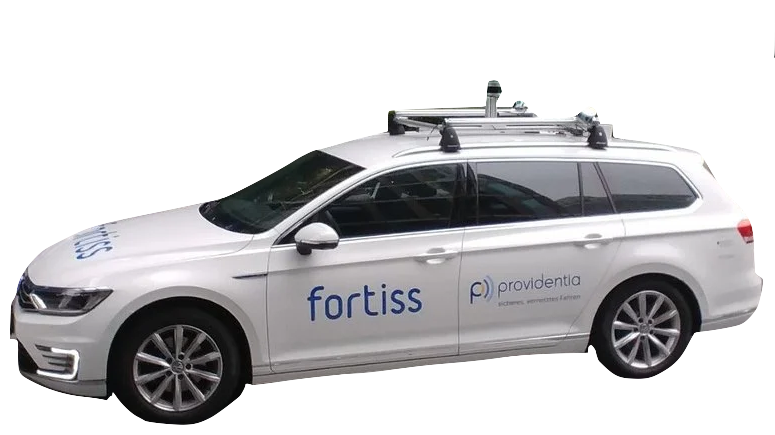
When I started working with Fortuna in 2023, the vehicle had been inactive for more than a year. I took responsibility for bringing it back into operation. This involved reconstructing parts of the existing architecture and operating procedures, restoring the software and hardware components needed for autonomous driving, and gradually making the vehicle usable for research again.
Today I lead the technical work around the vehicle. We use it for research on autonomous-driving testing, simulation, and real-world validation. Several students and researchers contribute to the platform and use it for their own work.
Inside the vehicle
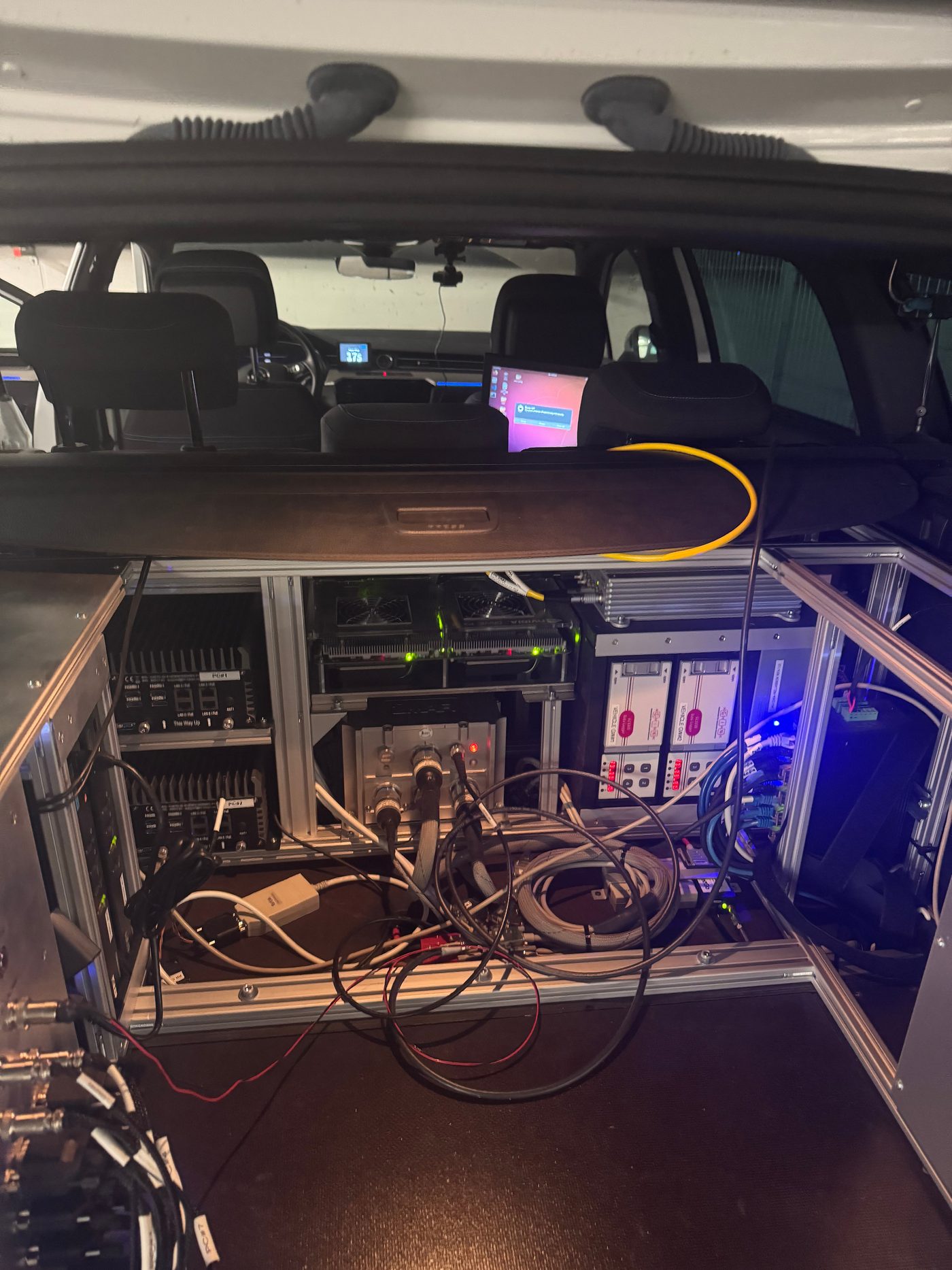
The driving stack can be an end-to-end model or a modular perception-planning-control pipeline. Bring your own laptop or PC, up to 1000 W, connect it over Ethernet, and start driving.
The platform
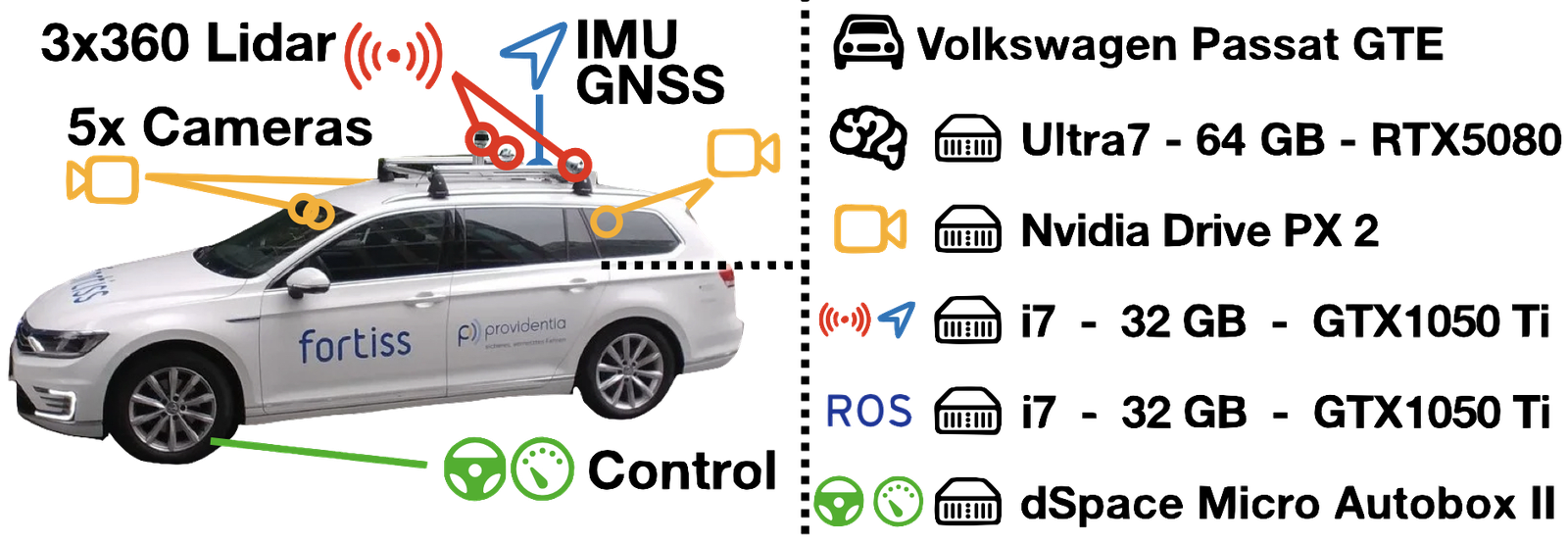
Fortuna is fortiss’s full-size autonomous-driving research vehicle: a retrofitted, street-legal Volkswagen Passat Variant GTE with five cameras, three LiDARs providing 360° coverage, precise localization, onboard compute, and real-time access to steering and acceleration through the vehicle gateway.
We use it to run the same research question across offline models, hardware-in-the-loop setups, and a complete moving vehicle, then compare where the answer changes.
Inherited, recovered, changed
Drive-by-wire actuation and control, the camera and LiDAR hardware, and the Apollo integration with GPS/IMU and the CAN bus—built for Providentia between 2016 and 2021.
In 2023, after more than a year of inactivity: reassessed every subsystem, restored communication paths, and made the vehicle inspectable and operable again.
A ROS bridge alongside Apollo so any laptop or PC can drive the car over Ethernet, modular and end-to-end driving stacks, simulation integration, hardware-in-the-loop infrastructure, and the small-scale Donkey Car platform.
Recovery → research
Fortuna wasn’t built for me. It was fortiss’s automated-driving prototype for Providentia—then the project ended, and the car sat unused.
2016–21
As fortiss’s 5G-connected automated-vehicle prototype, Fortuna gathered data alongside roadside sensor infrastructure for Providentia, a project researching connected, automated driving on Germany’s A9 digital motorway test bed near Munich. When the project ended in 2021, so did the car’s job.
2023
I assessed each inactive subsystem, restored communication paths, and made the vehicle inspectable and operable again.
2024–25
Rather than restore the original single-purpose setup, I rebuilt Fortuna as a modular, ROS-based platform: the driving stack can simply be swapped, and so can the compute behind it—any laptop or PC up to 1000 W, connected over Ethernet. With students joining the project, we integrated modular and end-to-end driving stacks, sensor pipelines, and simulation.
2026
For our ASE 2026 study, I compared 72 camera and LiDAR perturbations across offline analysis, hardware-in-the-loop execution, and closed-loop driving on Fortuna: more than 740 experiments and over 48 hours of autonomous driving.
NEXT
I keep connecting physical drives to reproducible scenarios, open tools, student projects, and research questions the next team can build on.
System anatomy
Hardware and logic
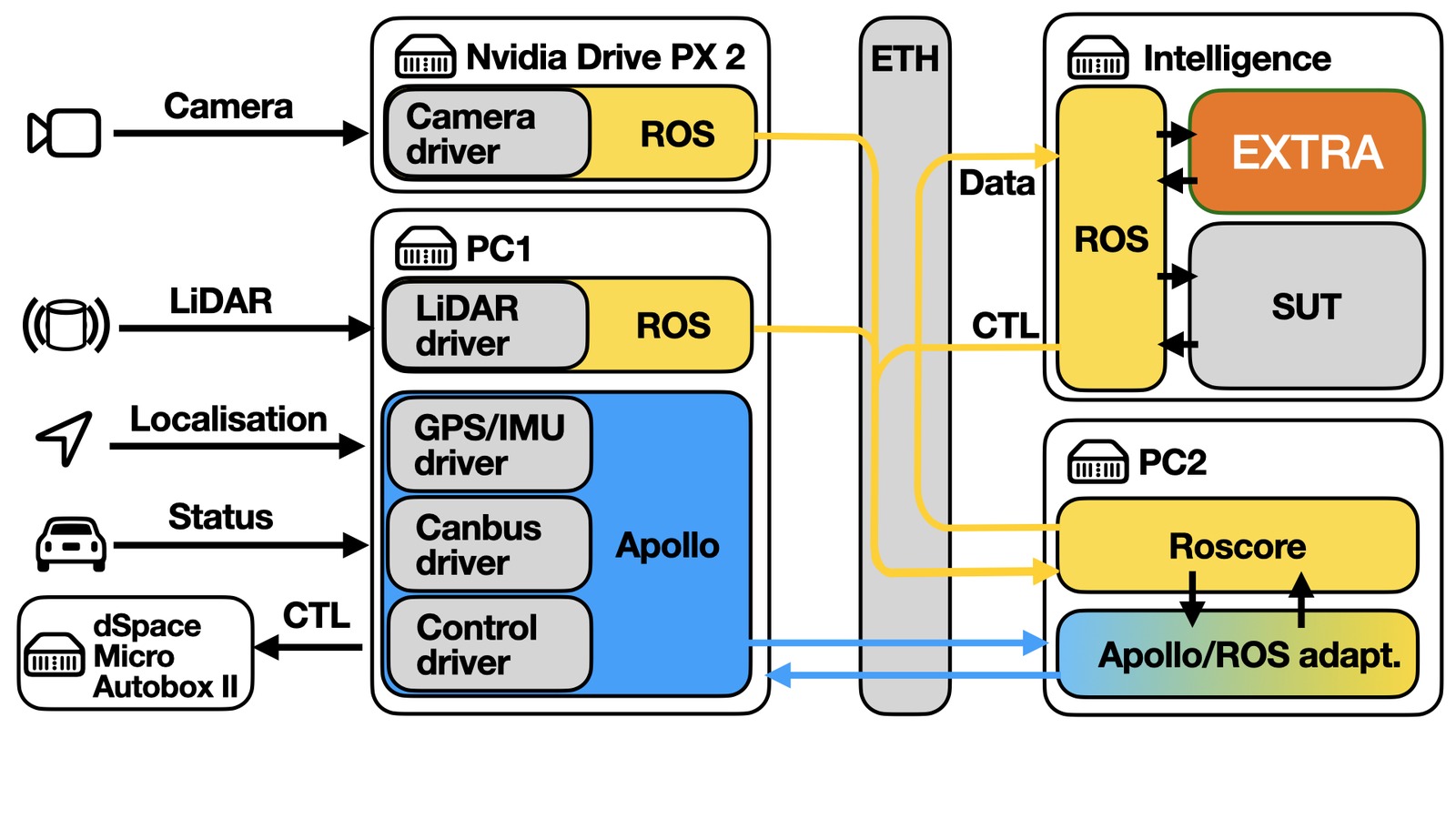
The original platform ran on Apollo alone. I expanded it into a distributed system: camera and LiDAR drivers publish over ROS from an Nvidia Drive PX2 and a dedicated PC, Apollo still owns GPS/IMU, the CAN bus, and the real-time control interface that talks to the dSpace MicroAutoBox II, and everything meets over Ethernet. A bridge machine runs the ROS master alongside an Apollo/ROS adapter, so a separate “intelligence” node (the system under test, plus whatever extra tooling a given experiment needs) can subscribe to sensor data and publish control commands without touching Apollo directly.
The small-scale platform
Fortuna has a smaller sibling: a 1/16-scale Donkey Car with its own small-scale lab and a mixed-reality framework built around a digital twin of that lab. For our ASE 2025 study, we used it to compare simulation, vehicle-in-the-loop, and mixed-reality testing against real driving—vehicle-in-the-loop reduced the actuation gap, and mixed-reality testing reduced the perception gap, compared to simulation alone.
Read the ASE 2025 paper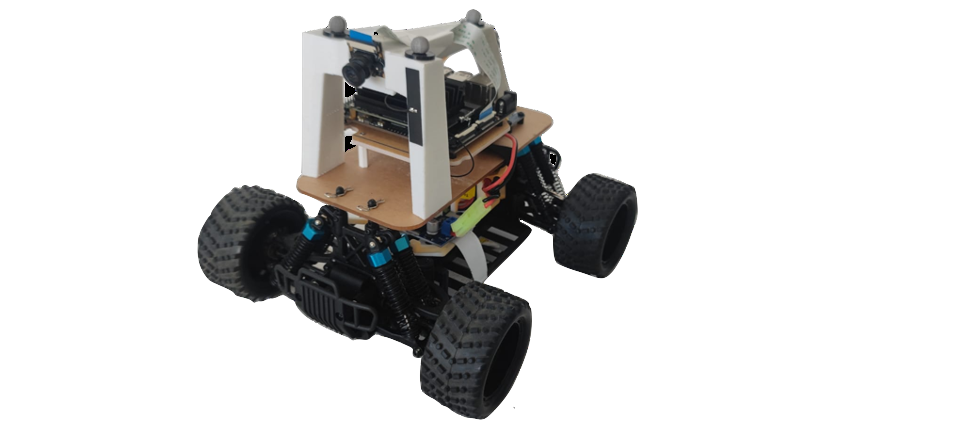
Not a one-person project
I lead the technical work around the platform under the supervision of Prof. Andrea Stocco, but the research around it is a shared effort. Here is some of the student projects that have grown around the platforms.
Davide built Cam2Sim, turning our recorded drives into playable, closed-loop CARLA scenarios.
Xun’s thesis studied how to adapt a model trained purely in simulation so it holds up in the real world.
As a bachelor’s student, Matthias co-led the real-world perturbation study that became our ASE 2026 paper.
Her master’s thesis became the ASE 2025 study comparing simulation, vehicle-in-the-loop, and mixed-reality testing on the small-scale platform.
For his bachelor’s thesis, Skander built a physical, IoT-connected traffic-light system for the small-scale platform.
As a bachelor's student, Hannes built PerturbationDrive, the image-perturbation framework for testing automated driving assistance systems.
Constantin's bachelor's thesis used Stable Diffusion and CARLA to reconstruct real driving scenarios and generate matching road layouts from recordings—the basis Cam2Sim was later built on.
Timo's industrial thesis, done in collaboration with BMW, automatically validates acoustic test-bench recordings of electric motors.
Gökce's thesis extends the ICST 2024 quality-metrics study to system-level testing on a physical vehicle.
Several of these students came through a practicum course I help organize on testing autonomous driving systems. More on teaching
Just for fun
You can take it for a lap around the track, no research question required.
Open it up