Research / simulation ↔ reality

Research.

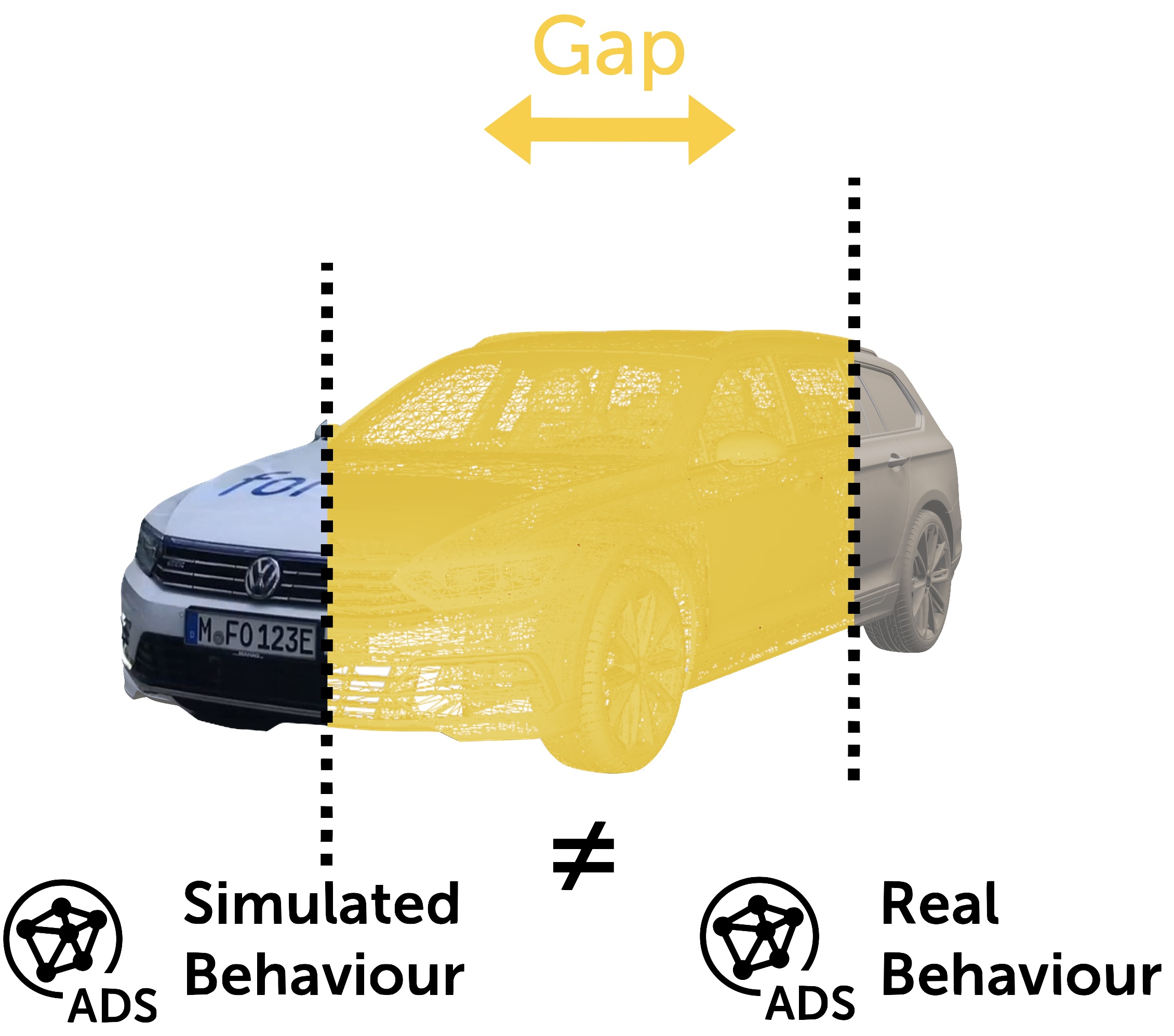
I study how well results transfer between simulation and the real world, how to make an autonomous-driving system more robust once that gap is measured, and how to reuse real driving data to make simulation more realistic.

Diagram showing the gap between an autonomous driving system's simulated behavior and its real behavior on the same road

Research themes

Six research themes.

02

Robustness under perturbation

Stress camera and LiDAR pipelines, then follow the effect beyond model accuracy into timing, planning, control, and system behavior.

Found: Offline robustness was only weakly predictive of closed-loop failures on the real vehicle; training on perturbed data improved robustness under adverse conditions.

04

Real-to-simulation reconstruction

Turn recorded road scenes into replayable simulations that preserve the geometry, trajectory, and visual character of the original drive.

Found: It's not a full replacement for the real environment, but it lets us reuse real drives for closed-loop testing.

Seeing it work

Demos.

Papers describe the method. These recordings show what it actually looks like.

Cam2Sim

Real drives, replayed in simulation.

Cam2Sim started from a practical problem. We had many hours of real driving recordings, but once an experiment was finished we could only replay the recorded sensor data. We wanted to turn these recordings into environments in which the driving system could interact again. Cam2Sim reconstructs the recorded environment in CARLA and uses Gaussian Splatting for the camera view. The reconstruction is not a complete replacement for the real environment, but it allows us to reuse real experiments for closed-loop simulation.

Read the paper

ASE 2025

The same reality gap, across three execution levels.

An open-source small-scale vehicle and its Unity digital twin, compared against Fortuna at full scale, across simulation, vehicle-in-the-loop, and mixed-reality testing.

Read the paper

PerturbationDrive

The same perturbation, any simulator.

PerturbationDrive generates camera perturbations—like rain, or a corrupted feed—and applies them through a simulator adapter, so the same scenario runs unchanged across Udacity's simulator, a small-scale digital twin, or a full driving stack. This recording walks through the scenario generator and simulator adapter behind the ICST 2025 benchmark.

Read the paper

Foresee

Forecasting near misses to focus fuzzing.

Foresee monitors nearby agents, classifies and ranks the riskiest ones, then clips and fuzzes the scenario around them—so testing time goes where failures are most likely to surface.

Read the paper

ICST 2024

Do image-quality metrics track what actually matters?

A recording of the ICST 2024 talk on assessing quality metrics for neural reality-gap input mitigation—testing whether standard image-quality metrics track how neural image translation affects a driving system's perception and control.

Read the paper

Earlier work on nano-drones

Before the reality gap

Fitting a neural network onto a 40-gram nano-drone.

Before autonomous cars, I worked on autonomous nano-drones. At the Dalle Molle Institute for Artificial Intelligence (IDSIA) in Lugano, I helped fit a relative-localization neural network onto a 40-gram nano-quadrotor: a single onboard camera and under 100 mW of power, enough to track a peer drone in real time (IEEE ICRA 2023). The platform changed; the question didn’t: what has to be true for a learned model to work outside the lab it was trained in?

Read the paper

Open research

A result is more valuable when someone else can interrogate it. The work is accompanied wherever possible by code, datasets, replication packages, and executable examples—from PerturbationDrive to Cam2Sim and vehicle-level artifacts.