2023–2026

Selected publications.

Peer-reviewed papers, executable tools, and replication packages on the reality gap, robustness under perturbation, and reusing real driving data for simulation. A complete list is available on DBLP.

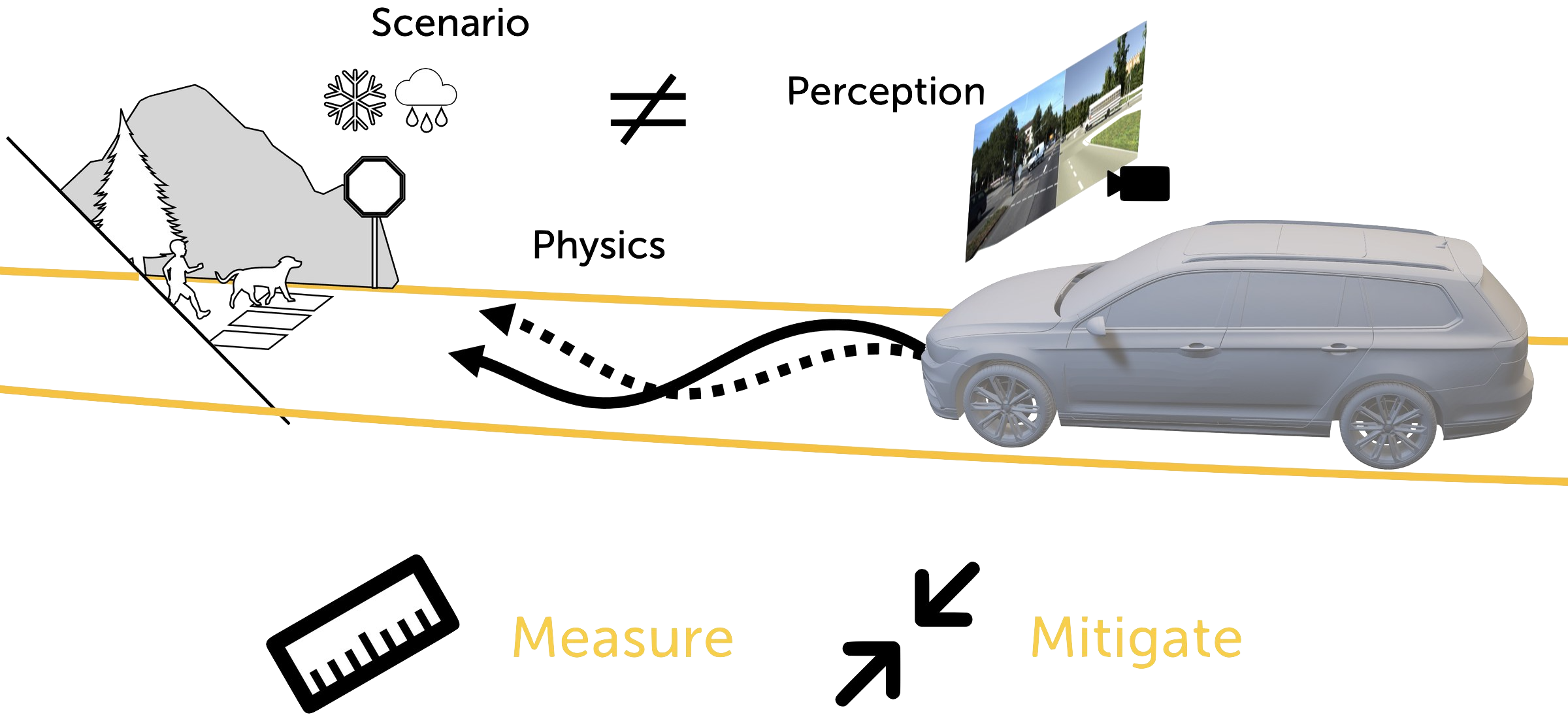
Diagram of the sim-to-real testing approach: a scenario runs through both physics and perception, is measured against real behavior, and mitigations feed back into the system
  1. 2026ASE

    Real-World Perturbation Testing of Autonomous Driving Systems

    Stefano Carlo Lambertenghi, Matthias Weil, Andrea Stocco

    We wanted to know whether robustness results measured offline predict what happens when the same perturbations are applied to an autonomous vehicle. We first tested the models offline and then repeated the experiments on Fortuna. Across more than 740 experiments, the relationship was weaker than we expected. We also tested whether fine-tuning on perturbed data improved real driving performance.

  2. 2026ICSE

    Misbehavior Forecasting for Focused Autonomous Driving Systems Testing

    M. M. Abid Naziri, Stefano Carlo Lambertenghi, Andrea Stocco, Marcelo d’Amorim

    We wanted to know whether we could predict which scenarios are likely to expose failures before running a full test suite. We built Foresee, which monitors nearby agents, ranks near misses by risk, and clips and fuzzes the scenario around them. Focusing the search this way found failures using a smaller testing budget than an unfocused search.

  3. 2026ASE · Tools & Datasets

    Cam2Sim: Neural Scenario Reconstruction for Closed-Loop Autonomous Driving Simulation

    Davide Jannussi, Stefano Carlo Lambertenghi, Constantin Carste, Andrea Stocco

    We had many hours of real driving recordings, but once an experiment was finished we could only replay the recorded sensor data. Cam2Sim reconstructs the recorded environment in CARLA and uses Gaussian Splatting for the camera view, so we can reuse real experiments for closed-loop simulation.

  4. 2026Science of Computer Programming

    PerturbationDrive: A Framework for Perturbation-Based Testing of ADAS

    Hannes Leonhard, Stefano Carlo Lambertenghi, Andrea Stocco

    PerturbationDrive started as the benchmark behind our ICST 2025 paper, but we wanted it to work as reusable infrastructure rather than a one-off study. This paper describes the resulting framework: more than 30 image perturbations, offline evaluation on static datasets, and online closed-loop testing across multiple simulators, combined with procedural road generation and search-based testing.

  5. 2025ASE

    A Multi-Modality Evaluation of the Reality Gap in Autonomous Driving Systems

    Stefano Carlo Lambertenghi, Mirena Flores Valdez, Andrea Stocco

    We wanted to know how much an autonomous driving system's behavior changes as it moves from simulation to a real vehicle, and whether an intermediate setup closes part of that gap. We compared simulation, vehicle-in-the-loop, mixed-reality, and real-world testing on a small-scale vehicle and its digital twin, for both end-to-end and modular models. Vehicle-in-the-loop reduced the actuation gap, and mixed-reality testing reduced the perception gap compared to simulation alone.

  6. 2025ICST

    Benchmarking Image Perturbations for Testing Automated Driving Assistance Systems

    Stefano Carlo Lambertenghi, Hannes Leonhard, Andrea Stocco

    We wanted to know which kinds of image perturbations expose weaknesses in automated-driving perception and control, and whether training on perturbed images helps. We benchmarked 38 perturbation types across camera-based driving systems. Training on perturbed images improved robustness under adverse conditions.

    IEEE Computer Society TCSE Distinguished Paper Award

  7. 2024ICST

    Assessing Quality Metrics for Neural Reality Gap Input Mitigation in Autonomous Driving Testing

    Stefano Carlo Lambertenghi, Andrea Stocco

    We wanted to know whether standard image-quality metrics track how neural image translation affects a driving system, rather than just how it looks to a human. We tested this across vehicle detection and end-to-end lane keeping using several metrics and translation methods. The metrics did not track downstream performance consistently across both tasks, which argues for using them carefully as a proxy.

  8. 2023ICRA

    Ultra-Low Power Deep Learning-based Monocular Relative Localization Onboard Nano-Quadrotors

    Stefano Bonato, Stefano Carlo Lambertenghi, Elia Cereda, Alessandro Giusti, Daniele Palossi

    We wanted to know whether two nano-drones could localize each other in real time using only a single onboard camera, within the power budget of a 40-gram quadrotor. We trained a small neural network for this and deployed it onboard. It ran at 48 Hz using about 95 mW and reached a mean localization error of about 15 cm in flight tests.